
Par Null Byte 2018
698 k abonnés
How to Find Domains for Phishing Attacks with Dnstwist
Full Tutorial: https://nulb.app/x4ad1
En ligne :
https://dnstwist.it
https://dnstwister.report
cf. https://liens.vincent-bonnefille.fr/?bKaWvA
==
https://squatted.online/squat/main_entrance/staircase/floor_0/back_door/neglected-garden/ >>>
https://github.com/squatted-online/bemused-90.63
"It is difficult to transpose the radical practice of squatting into a virtual space for three main reasons. First, because there is no virtual property that is not anchored to a technological and material substratum (the servers). Secondly, because the membrane that separates on-line and off-line life has definitely disappeared. And finally, because there are fewer and fewer spaces for the collective co-management of services, and more and more interactions are mediated by huge monopolies [...].
The occupation of a virtual space cannot have the same iconic force, because it would be flooded by the flow of data from millions of similar projects, disappearing into the flatness of image grids and research hierarchies.
More than pirates and adventurers, today we find ourselves living in a condition of perennial tourism: we temporarily rent houses, rent music, movies, and video games. Nothing belongs to us and at the same time, everything is at our disposal for free, provided that we use it from inside a prison cell or in the production line of a mega-factory.
Disused or closed sites, outdated social networks, the last pages of a Google search are digital ruins, decadent and romantically fascinating places. These monasteries, castles and virtual cemeteries are hidden and almost erased by the global mapping and enclosure operation carried out by the capital's platforms.
Rather than re-occupy these spaces, we simply want to give the possibility to make them visible, to delete and rewrite the great map of the net, a cyber-geographic drift."
Quote livre ( dante to the cyberspace ?! )
https://www.margaretwertheim.com/physics-from-the-fringe-1
>>>>
SEO et liens naturels... site de référence en à la matière
https://ahrefs.com/blog/search-traffic-study/
Voir aussi en français https://semji.com/fr/guide/backlink-en-seo/

+ https://blogs.mediapart.fr/abahcmoi/blog/050519/propos-de-la-societe-ingouvernable-de-gregoire-chamayou
Dans ma bibliothèque ::
https://bib.vincent-bonnefille.fr/book/96

" Exposé donné par @Antoinette_Rouvroy dans le cadre de la @Chaire_Géopolitique_du Risque , organisée par le département de Géographie de l'ENS " 2016
@ENS_École_normale_supérieure
https://invidious.fdn.fr/watch?v=bNN3PMkMSfY :
" Après m'être d'abord intéressée au potentiel "prédictif" des tests de dépistage et de diagnostic génétiques et ses implications en termes d'égalités, d'opportunités sur les marchés de l'emploi et de l'assurance ainsi que dans les débats relatifs à l’État providence aux États-Unis et en Europe, j'ai commencé à m'intéresser aux implications juridiques, politiques et philosophiques des nouvelles pratiques statistiques nourries par les données numériques disponibles en quantités massives (les big data).
... Je me suis rendue compte que ces nouvelles pratiques de détection, de classification et d'évaluation anticipative des propensions et comportements humains fondées sur les techniques du numérique constituaient de nouveaux modes de production du "savoir", de nouvelles modalités d'exercice du "pouvoir", et de nouveaux modes de "subjectivation", bref, une nouvelle gouvernementalité algorithmique, succédant, en quelque sorte, sans pour autant les remplacer complètement, aux régimes de pouvoir - souveraineté (droit de laisser vivre et de faire mourir), régime disciplinaire (réforme des psychismes individuels par intériorisation des normes, que les individus disciplines "incarnent" d'eux-même) et biopouvoir (droit de faire vivre ou de laisser mourir) - mis en lumière par Michel Foucault.
@Antoinette_Rouvroy , docteur en sciences juridiques de l'Institut universitaire européen (Florence, 2006), est chercheuse qualifiée du FNRS au centre de Recherche en Information, droit et Société (CRIDS). "

Par @Lawrence_Lessig – janvier 2000 – Harvard Magazine
(Traduction Framalang : Barbidule, Siltaar, Goofy, Don Rico)
"Nous sommes à l’âge du cyberespace. Il possède lui aussi son propre régulateur, qui lui aussi menace les libertés. Mais, qu’il s’agisse d’une autorisation qu’il nous concède ou d’une conquête qu’on lui arrache, nous sommes tellement obnubilés par l’idée que la liberté est intimement liée à celle de gouvernement que nous ne voyons pas la régulation qui s’opère dans ce nouvel espace, ni la menace qu’elle fait peser sur les libertés."
[...]
Cette régulation est en train de changer. Le code du cyberespace aussi.
Et à mesure que ce code change, il en va de même pour la nature du cyberespace.
Le cyberespace est un lieu qui protège l’anonymat, la liberté d’expression et l’autonomie des individus,
il est en train de devenir un lieu qui rend l’anonymat plus difficile, l’expression moins libre et fait de l’autonomie individuelle l’apanage des seuls experts.
[...]
Le code élémentaire d’Internet est constitué d’un ensemble de protocoles appelé TCP/IP. Ces protocoles permettent l’échange de données entre réseaux interconnectés. Ces échanges se produisent sans que les réseaux aient connaissance du contenu des données, et sans qu’ils sachent qui est réellement l’expéditeur de tel ou tel bloc de données. Ce code est donc neutre à l’égard des données, et ignore tout de l’utilisateur.
Ces spécificités du TCP/IP ont des conséquences sur la régulabilité des activités sur Internet. Elles rendent la régulation des comportements difficile. Dans la mesure où il est difficile d’identifier les internautes, il devient très difficile d’associer un comportement à un individu particulier. Et dans la mesure où il est difficile d’identifier le type de données qui sont envoyées, il devient très difficile de réguler l’échange d’un certain type de données. Ces spécificités de l’architecture d’Internet signifient que les gouvernements sont relativement restreints dans leur capacité à réguler les activités sur le Net.
[...]
Si c’est le code qui détermine nos valeurs,
ne devons-nous pas intervenir dans le choix de ce code ?
Devons-nous nous préoccuper de la manière dont les valeurs émergent ici ?
[...]
Des gens décident comment le code va se comporter.
Des gens l’écrivent. La question n’est donc pas de savoir qui décidera de la manière dont le cyberespace est régulé : ce seront les codeurs.
[...]
quand l’État se retire, la place ne reste pas vide. Les intérêts privés ont des objectifs qu’ils vont poursuivre.
En appuyant sur le bouton anti-Étatique, on ne se téléporte pas au Paradis. "
à retrouver sur mon World of Text ::
https://www.yourworldoftext.com/~vincentb/
X : 1 Y : -5
Conférence, ressources : https://liens.vincent-bonnefille.fr/?NZY9jg

[...]
« Code Is Law » devient de plus en plus « Law Is Code ». Les principes du droit d’auteur peuvent en effet être transcrits en langage machine et interprétés automatiquement par des algorithmes. C’est la logique depuis longtemps à l’oeuvre derrière les DRM (Digital Right Management), première tentative technique d’agir sur le Code pour le mettre en conformité avec la loi. Mais au-delà des DRM, le « Droit de Regard de la Machine » déborde aujourd’hui les simples verrous numériques pour déboucher sur des systèmes de surveillance et de contrôle à grande échelle.
[...]
La question est alors de savoir comment préserver le Code originel, garant de l’exercice des libertés sur Internet, pour éviter cette injection robotisée d’un droit négocié entre acteurs privés, directement au coeur des protocoles et des algorithmes s’appliquant à l’essentiel de nos échanges en ligne."
Il retrace la lutte anti-piratage et ripostes telles Hadopi / Lopsi 2 qui avait mené à un black-out du web :
http://phanux.web.free.fr/index.php?article12/hadopi-black-out
https://en.wikipedia.org/wiki/Protests_against_SOPA_and_PIPA
Conférence :
https://www.slideshare.net/calimaq/law-is-code-comment-la-proprit-intellectuelle-menace-larchitecture-ouverte-dinternet
https://vimeo.com/87071130 ( 2012 )
---
Par @Calimaq : Aka @Lionel_Maurel . Juriste & bibliothécaire
On le connait aussi pour ses Copy-Madness (compilation des aberrations produites la course au Copyrigth) qu'on retrouve sur son blog ou sur https://www.numerama.com/tag/copyright-madness/
Il est membre de @La_Quadrature_du_Net .
__
@Lawrence_Lessig auteur de "Code is law : Le code, et les autres lois du cyberespace"
/ https://lessig.org/product/code/ puis
/ https://lessig.org/product/codev2/
* https://framablog.org/2010/05/22/code-is-law-lessig/ ( en français )
* https://harvardmagazine.com/2000/01/code-is-law-html
> https://liens.vincent-bonnefille.fr/?OEdrKg
2000 2010 2011 2012

Voir aussi https://cosmo-orbus.net/blog/sf/les-hauts-parleurs-alain-damasio/
2015
> quoted here https://liens.vincent-bonnefille.fr/?Tef4wA
- Structures formelles et informelles
- La nature de l’élitisme
- Le système des stars
- L’impuissance politique
"Tout au long des années de formation du Mouvement de Libération des Femmes, on a beaucoup plébiscité les dénommés « groupes sans leader ni structure », comme étant la principale, sinon l’unique forme d’organisation du mouvement. L’origine de cette idée se trouve dans la réaction naturelle à la société sur-structurée dans laquelle nous sommes plongé-e-s, à l’inévitable contrôle sur nos vies qu’elle confère à certain-e-s, et à l’élitisme constant de la gauche et de groupes similaires parmi celles et ceux qui étaient supposé-e-s combattre cette sur-structuration. [...]"
> quoted here https://liens.vincent-bonnefille.fr/?Tef4wA

musique and... folow the crowd of cursors
Espace web infini Hotglue
alternativeto : EtherPad (,;
"Your World of Text is an infinite grid of text editable by any visitor. The changes made by other people appear on your screen as they happen. Everyone starts in the same place, but you can scroll through the world using your mouse."
https://www.yourworldoftext.com/~vincentb/ ( projet_perso )
https://elmcip.net/creative-work/your-world-text ( Recherche, litterature 2.0 )
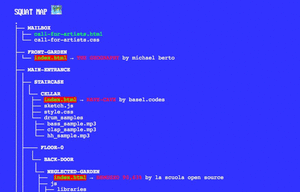
`-. U P E R cool folder-architectured co-www-exhibition index page ftp ( 2020 )
`-'
@the_wrong : digital art biennale https://thewrong.org
the squatted.online embassy reflects on the possibilities of squatting a digital space ♦ in the context of our exhibition, we try to look at the internet as an architectural space where each webpage is a building ♦
+>
https://squatted.online/squat/mailbox/call-for-artists.html : 2019 :
Back in 2003 , Steven Johnson [1] highlighted some of the major aspects of the internet by describing it as a city. Indeed, the web has been built and experienced by many people; wide participation has fueled its growth, yet this interconnection is cordoned into parts, each retaining its own independence.[...] For this reason, algorithms on social media, or any other kind of tracking algorithms, act as a reminder that the promise of a free internet has evolved into a powerful surveillance tool.
...
Edit javascript into a html page with `eval()`...
https://squatted.online/squat/main_entrance/staircase/meta-mezzanine/
Some strange blank pages with strange links in source code
An happy messy place
...
txt interessant sur le cyber-squatting, ses limites (et contradictions)
https://liens.vincent-bonnefille.fr/?QE9y1Q
---
Electro + eZine édition_zine
https://squatted.online/squat/main_entrance/staircase/floor_2/bedroom_1/drawer/index.html
via : https://www.are.na/minkyoung-kim/low-tech-network

1 Websites are places. They provide services and social environments. Like architecture, they distribute access and atmospheric context to these resources: Watching a video on Nowness is different from watching a video on YouTube.
2 Websites are inherently public. Architecture is by nature a public discipline. Both buildings and websites are built realities. They are part of the fabric of societies that are now both physical and virtual.
3 Websites are inhabited. They become part of societies through the interactions they enable. They are homes to communities, to thoughts and approaches. They may be privately owned and operated, but inhabited and used by the public. As buildings, websites are where we spend our lives.
4 Websites are local, despite their distributed nature. Websites adhere to culturally established patterns, languages and user expectations in similar ways architecture does. Buying an onigiri from a 7-11 branch is different from buying a pretzel from a Bavarian bakery.
Welcome to the Old Internet Again !
. an other one .
https://www.404pagefound.com
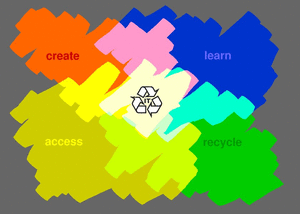
A rant approximating the content of this document was delivered to an audience of new media artists and activists by James Wallbank, Coordinator of Redundant Technology Initiative, at The Next 5 Minutes conference in Amsterdam, March 1999 .
=================
' "Lowtech" means technology that is cheap or free.
Technology moves on so fast that right now we can recover low-end Pentiums and fast Macintoshes from the trash. Lowtech upgrades every year. But we don't have to pay for it.
Lowtech includes hardware and software. We advocate freeware and low cost software. We particularly advocate the use of low cost, open source operating systems.
[...]
Lowtech counters exclusivity. Lowtech is street level technology.
Text is great for communicating. Write down what you want to say. Make it clear and simple and non-exclusive.
Email is still the "killer app". Fast, low cost global communication for the ordinary citizen is genuinely something new.
HTML is good for lots more than web pages. Now you can author all sorts of graphical stuff with a plain text editor.
Use the web for plain text and images. It's simple and cheap and quick and it works.'


Low-tech Magazine questions the belief in technological progress, and highlights the potential of past knowledge and technologies for designing a sustainable society. Because a web redesign was long overdue — and because we try to practice what we preach — we decided to build a low-tech website that meets our needs and abides by our principles. 2020
Articles :
https://solar.lowtechmagazine.com
- How and why I stopped buying new laptops
- How to Make Biomass Energy Sustainable Again
- The Solar Powered Website in Spanish, French, and Other Languages
- How to Make Wind Power Sustainable Again
- Keeping Some of the Lights On: Redefining Energy Security
- How Circular is the Circular Economy?
@viaa Olia webring inpired
- Is a situated technology. She has a sense of context and considers herself to be part of an ecology of practices
- Is run for and by a community that cares enough for her in order to make her exist
- Builds on the materiality of software, hardware and the bodies gathered around it
- Opens herself to expose processes, tools, sources, habits, patterns
- Does not strive for seamlessness. Talk of transparency too often signals that something is being made invisible
- Avoids efficiency, ease-of-use, scalability and immediacy because they can be traps
- Knows that networking is actually an awkward, promiscuous and parasitic practice
- Is autonomous in the sense that she decides for her own dependencies
- Radically questions the conditions for serving and service; experiments with changing client-server relations where she can
- Treats network technology as part of a social reality
- Wants networks to be mutable and read-write accessible
- Does not confuse safety with security
- Takes the risk of exposing her insecurity
- Tries hard not to apologize when she is sometimes not available
.
@viaa https://homebrewserver.club
@viaa http://radical-openness.org/en

//Evgeny_Ponomarev, Jun 8, 2020
Web 3.0 vs DWeb
Study Participants & Demographics
The Current Web
3.1 Pain Points
3.2 Web Protocols
The DWeb
4.1 The Meaning of Decentralization
4.2 Values and Mission
4.3 Technical Challenges
4.4 DWeb Tech Usage in the Future
Adoption of the DWeb
5.1 Biggest Obstacles
5.2 The Missing Piece
5.3 The Role of the Blockchain
DWeb Projects Profile
6.1 Categories
6.2 Motivation
6.3 Status and Team
6.4 Technology
6.5 Business

"Feedless combines the best original ideas of popular social networks without the bad parts
- You have your own wall, but you can only post with 140 characters, like original Twitter
- If you want to check on others you have to go to their profile, like original Facebook or Orkut
- You can send secret messages, like original Snapchat , but there are no stories
- There is no feed to scroll forever, no cassino slot machine addiction
- There are no likes nor any mindless interactions, if you like something, you tell the person, like a human"
Moi :: https://feedless.social/profile/@ebM+yMNwA1VI6smUS+73B/n/IYePXI4/Bf2rYYRkkqY=.ed25519
On trouvera aussi un article au sujet de Minus, une alternative "décroissante" à Twitter
https://usbeketrica.com/fr/article/a-quoi-ressemblerait-un-reseau-social-decroissant
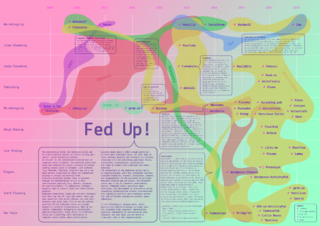
ActivityPub
>> https://gitlab.com/lidia_p/fediposter/
>> http://redecentralize.github.io/alternative-internet/ proto altweb annuaire_index VPN dns