
[DEAD] Waybackmachine
I follow an exercise program every day. The app on my phone tells me exactly what to do and how long to do it, and I like that because the goals are set for me, and I know that if I follow the instructions I will gain fitness.
..
Nothing like this exists for the fine art world. It works so well, though, that I started to wonder whether even a basic instruction set could be created.
.
What follows is a two-stage process for creating a sustainable artist project that won’t end in burnout or bankruptcy.
A TEN-STEP GUIDE TO CREATING A SUSTAINABLE ARTIST SPACE
TIPS FOR MAKING ARTIST SPACES SUSTAINABLE
@TCI : The Creative Independent
2019
@Becca_Abbe
In the early 1970s, a group of technocrats and members of the business elite formed an international organization called the Club of Rome. Together, they commissioned a team of M.I.T. researchers to run a computer analysis of Earth’s finite resources against the exponential growth of human activity.
...
WELL ("Whole Earth 'Lectronic Link”)
...
Low_Tech supports the idea that a website can serve a small community connected through common interests. The Internet's global accessibility has lead us to think on a massive scale, but a community that lacks physical proximity can still be “local” in mindset.
...
A website can be a testing ground, a micro-utopia, or a safe haven, offering relief from the commodified web.

2016 by @Silvio_Lorusso
https://vimeo.com/148146455
[ Video + transcript of the talk I gave at the ‘Artistic Interventions in Finance’ panel during @MoneyLab : Economies of Dissent 2015 ]
"Today, I’m gonna talk about a project called //Kickended and the path that my research took from there. Made in 2014 , //Kickended is a Kickstarter clone that only includes campaigns nobody wanted to pledge for. Campaigns that raised exactly zero dollars.
[...]
Kickended itself is the result of a failure — if you want to call it like that — since I originally submitted the idea to Rhizome’s Net Art Microgrants competition. Kickended made it to the final round but, unfortunately, it didn’t go through."
Fake It Till You Make It :
https://youtu.be/0yKig9gGwko
https://liens.vincent-bonnefille.fr/?OXX4gg
ads_tracking
on retrouve ce projet dans cette compilation d’œuvres web.art @rhizome 2014
https://rhizome.org/editorial/2014/sep/11/announcing-microgrant-juror-finalists/

/// Fake it ‘till you make it. Act as if it were true until it actually becomes true.
Standing desk, monitor, tablet, Hooli mug, "Delivering Happiness" book, money tree, Installation, Video, with #&Goethe_Institut, 2016
Sometimes recommended as a way to cope with depression, ‘fake it ‘till you make it’ is also a common catchphrase in the field of startups. Here, it refers to the strategy of pretending that the product is already functional in order to make it more appealing to investors.

___
___
Vidéo :: https://youtu.be/cRmRvBSHlgQ
....., Gabriela Rojas-Lozano ( Captcha Vidéo resolution )
[ 2019 ] While we were still just collecting, in 2015, Gabriela Rojas-Lozano filed a class action lawsuit against Google. She claimed that Google “operates a highly profitable transcription business built upon free labor, which it deceptively and unfairly obtains from unwitting website users”.
via :: Humans As Software Extensions - Sebastian Schmieg http://sebastianschmieg.com/text/humans-as-software-extensions/
...
Me fait penser au site http://www.9kw.eu/
Curation, Event, Exhibition, with Onomatopee, 2019
/// Now that the prospect of full automation is once again getting traction, the shared hope is to delegate every task to intelligent machines. But as we await the full takeover of smart robots, work is delegated to machines and humans alike. It makes no difference to companies and entrepreneurs: while some machines begin to look human_like, some humans are disguised as machines, by means of seamless interface design or blatant deception. This is what Astra_Taylor calls fauxtomation.
/// Participating Artists & Speakers
Cory Arcangel
Deconstructeam
Constant Dullaart
Andy Kassier
Alina Lupu
Elisa Giardina Papa
Ottonie von Roeder
Sebastian Schmieg
Stefán Stefánsson
Pilvi Takala
Jeff Thompson
Exhibition at Aksioma,
Installation, 2019
...
Hyperemployment, curated by //#·Domenico_Quaranta
“Labour – one of the defining aspects of our capitalistic societies – is also one of the sides of contemporary life that has been more affected by technological innovations and by the advent of post-Fordism. Although increasing automation has actually caused many forms of human labour to disappear, it has not – as many thinkers have predicted – brought an end to labour. Instead, it has led to – together with other innovations, such as the rise of device culture and social networks – its fragmentation into plenty of micro labours and its infiltration into every moment of life.
+++
Thématique, développement (article)
https://networkcultures.org/entreprecariat/shouldnt-you-be-working/ <3
Slow up your computer hack
http://slowhotcomputer.com
Gagner du temps ( sketch Jerry Seinfeld ) fun
https://youtu.be/TbP4Kt6359E
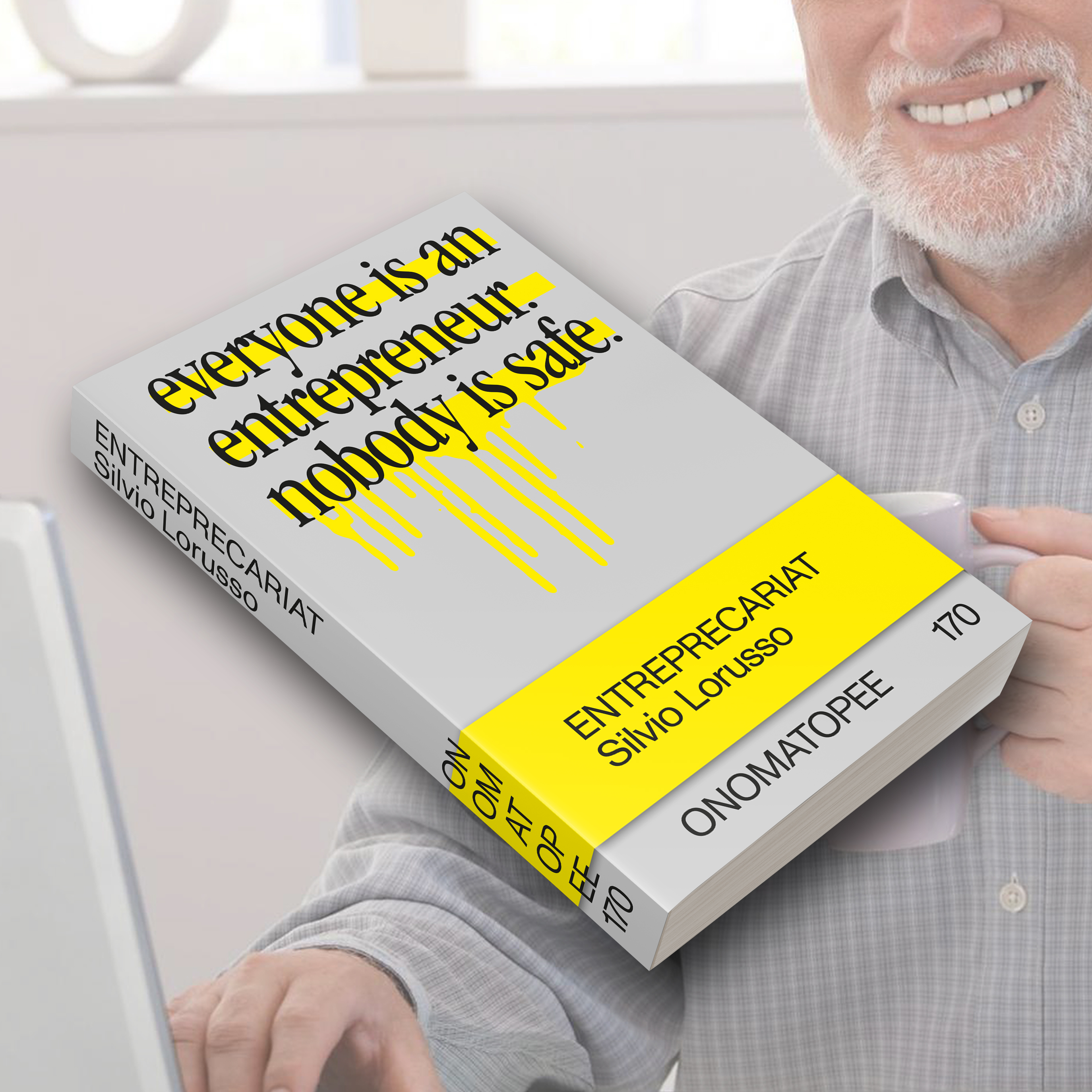
Book, Publication, with Onomatopee, 2019
Entrepreneur or precarious worker? These are the terms of a cognitive dissonance that turns everyone’s life into a shaky project in perennial start-up phase. @Silvio_Lorusso guides us through the entreprecariat, a world where change is natural and healthy, whatever it may bring. A world populated by motivational posters, productivity tools, mobile offices and self-help techniques. “A compelling and relentless j’accuse: debunking the social and political myths that push an increasing number of persons to perform in the entrepreneurship circus — with no safety nets.”
—£ @Antonio_Casilli , author of En attendant les robots, 2019
L’essai vidéo met en scène la tension entre travail_camouflé et loisir_créatif. Les deux témoignages rendent compte pour le premier d’une approche de passionné tirant satisfaction de la reconnaissance de son talent par le géant de l’informatique, l’autre, plus critique, décelant une forme de travail_déguisé : « je crois que cette fois on s’est vraiment bien fait avoir. Tout était tellement bien foutu, c’est ça, tellement bien foutu, qu’on ne savait même plus qu’on travaillait quand on travaillait… »
Date de réalisation : 2011
Vidéo HD, couleur, son, 7'41''
Réalisation : Julien Prévieux

Like many other machine vision datasets (e.g. ImageNet), Microsoft’s COCO image recognition dataset is based on photos culled from Flickr. The dataset’s true value derives from the 600.000+ segmentations manually created by Mechanical_Turk crowd workers, based on those photos from Flickr. With Segmentation.Network I created a piece in which all segmentations are played back in a random order, making visible some of the manual labor that goes into building artificial intelligence.
exposition ++ https://silviolorusso.com/work/do-or-delegate/
via :: http://sebastianschmieg.com/text/humans-as-software-extensions/

In 2016, Donald Trump’s team hired a Singaporean teenager through Fiverr (the platform I talked about earlier) to convert a PowerPoint into a Prezi, basically outsourcing the “Make America Great Again” campaign. In my recent speculative video piece I Will say Whatever You Want In Front Of A Pizza, the protagonist who is not only working as a pizza delivery bot but also as a cloud-worker on Amazon’s Mechanical Turk platform gets to know this Singaporean teenager.
///
via :: http://sebastianschmieg.com/text/humans-as-software-extensions/
...
Ref. vidéo itw Singaporean ::
https://www.todayonline.com/singapore/tech-savvy-sporean-teen-played-part-trump-campaign

# Article à ce sujet ( anglais )
http://sebastianschmieg.com/how-to-appear-offline-forever/
We are part of the privileged third of the world’s population that has access to the Internet. Teams at Facebook and Google are working on projects to build swarms of solar powered drones and balloons that would allow more people to connect to the Internet and take part in digital life. How to Appear Offline Forever explores visibility, labour and colonialism in a networked world, taking the endeavours of Internet drones as the starting point for intertwined stories happening in different places. [...]
Commissioned by @Abandon_Normal_Devices
https://www.andfestival.org.uk <3
God is code
!Mediengruppe Bitnik,
Rybn
cryptocurrencies

JavaScript is dangerous! Why? How are websites vulnerable to it? Find out about bug-bounties from @Tom_Scott


" True stories from the dark side of the Internet
This is a podcast about hackers, breaches, shadow government activity, hacktivism, cybercrime, and all the things that dwell on the hidden parts of the network. This is Darknet Diaries. "
-- très bonne série de podcasts sur l'imaginaire hacker, les actualités-retours autours de faits marquant de l'informatique-sécurité contemporaine . Des feuillons, des témoignages... de qualité et accessible (bien qu'en anglais)
Une émission @France_Inter de 2021
https://www.franceinter.fr/emissions/la-chronique-de-thomas-biasci/la-chronique-de-thomas-biasci-du-vendredi-05-novembre-2021

MSCHF X GUO O DONG
---
This page was livestreaming The Persistence of Chaos, a laptop running 6 pieces of malware that have caused financial damages totaling $95B. The piece is isolated and airgapped to prevent against spread of the malware.
--
( Bidding for a laptop infected with six of the world’s most famous computer viruses—WannaCry, BlackEnergy, ILOVEYOU, MyDoom, SoBig and DarkTequila—has topped more than $1.1 million at auction.
https://www.vice.com/en/article/vb93jx/a-computer-afflicted-with-6-infamous-viruses-has-passed-dollar1-million-at-auction )
__
Un article en français
https://news.artnet.com/market/malware-artwork-goes-to-auction-1554505

(( via @Le_Média : 2021 , ANNÉE DE LA CENSURE ?
(( Trump censuré de twitter facebook
(( l’interopérabilité vers des services décentralisés
(( https://www.youtube.com/watch?v=3EofN9fnW6E
Article de la @La_Quadrature_du_Net, 2019
"Le protocole permet l’interopérabilité. L’interopérabilité est la capacité à communiquer de deux logiciels différents, issus d’équipes de développement différentes. Si une université bolivienne peut échanger avec une entreprise indienne, c’est parce que toutes les deux utilisent des protocoles communs.
L’Internet est un réseau à « permission facultative ». Contrairement aux anciennes tentatives de réseaux informatiques qui étaient contrôlés par les opérateurs téléphoniques, et qui décidaient de quels protocoles et quelles applications tourneraient sur leurs réseaux, sur l’Internet, vous pouvez inventer votre propre protocole [...]
Si chaque développeur ou développeuse d’applications invente son propre protocole, il n’y aura plus de communication ou, plus précisément, il n’y aura plus d’interopérabilité. Chaque utilisatrice et chaque utilisateur ne pourra plus communiquer qu’avec les gens ayant choisi le même logiciel.
[...]
Certains services sur l’Internet bénéficient d’une bonne interopérabilité, le courrier électronique, par exemple [#email]. D’autres sont au contraire composés d’un ensemble de silos fermés, ne communiquant pas entre eux. C’est par exemple le cas des messageries instantanées. [...] Alors que l’Internet était conçu pour faciliter la communication, ces silos enferment au contraire leurs utilisateurs et utilisatrices dans un espace clos.
Un exemple d’un succès récent en termes d’adoption d’un nouveau protocole est donné par le Fédivers . Ce terme, contraction de « fédération » et « univers » [...] regroupe tous les serveurs qui échangent entre eux par le protocole ActvityPub [qui] permet d’échanger des messages très divers.
[Les protocoles ne sont pas tous régis par des spécifications strictes]. Ainsi le protocole BitTorrent, très utilisé pour l’échange de fichiers, et pour lequel il existe une très bonne interopérabilité, avec de nombreux logiciels, n’a pas fait l’objet d’une spécification complète.
Parfois, la spécification est adoptée formellement par un organisme dont le rôle est de développer et d’approuver des spécifications. C’est ce qu’on nomme la normalisation. Une spécification ainsi approuvée est une norme. L’intérêt d’une norme par rapport à une spécification ordinaire est qu’elle reflète a priori un consensus assez large d’une partie des acteurs, ce n’est plus un acte unilatéral.
L’une des organisations de normalisation ouverte les plus connues est l’IETF (Internet Engineering Task Force, qui produit notamment la majorité des RFC). L’IETF a développé et gère la norme décrivant le protocole HTTP, le premier cité dans cet article. Mais d’autres organisations de normalisation existent comme le W3C (World-Wide Web Consortium) qui est notamment responsable de la norme ActivityPub .
Le courrier électronique repose, contrairement à la messagerie instantanée, sur des normes ouvertes, mais on peut respecter ces normes tout en ajoutant des règles. Ce bras de fer vise à empêcher les serveurs indépendants de communiquer avec Gmail .
Si on laisse beaucoup de choix aux programmeuses et programmeurs qui créeront les logiciels, il y a des risques de casser l’interopérabilité, suite à des choix trop différents. Mais si on contraint ces programmeuses et programmeurs, en imposant des règles très précises pour tous les détails, on empêche les logiciels d’évoluer en réponse aux changements de l’Internet ou des usages. La normalisation reste donc un art difficile, pour lequel on n’a pas de méthode parfaite."

Scammers have taken an old browser scam and invigorated it using a clever and new tactic that takes advantage of your web browser's full-screen mode to show a fake Windows 10 desktop stating your computer is locked.
This type of scam is called a police browser locker. which pretends to be law enforcement locking your browser because due to illegal activity. These scams then state that if you pay a fine via a credit card, it will unlock your computer so you can use it again.